




The Pharisee and the Tax Collector

Luke 18:9-14
In the temple, the Jews’ central location of worship, Jesus is directing attention to the self-righteous. They were known for their strict observance of the law and frequently considered themselves morally and religiously superior. Posing in prayer, the Pharisees looked down on robbers, crooks, adulterers, and even this lone, quiet, humble tax man.
Simile. Two men go up to pray in the temple. One is expressing prayer in worldly fashion, showing off, standing up to be noticed and heard by all. The other stands at a distance, looks up to heaven, beats his breast, and cries out for God’s mercy. The tax collector is fully cognizant of his sinfulness and his desperate need for the grace of God.
Contrast. The self-righteous Pharisee stands in stark disparity with the brokenness and humility of the tax collector. Jesus is using these distinctions as examples of how we choose to pray. The Pharisee is obviously puffed up with pride in his prayers. The tax collector, however, is aware of his brokenness, beating his breast in sorrow as he cries out for God’s mercy.
Lectio Divina
Pause—Sit silently and reverently with the Lord and invite his presence to be made known to you during this prayerfully reflective experience.
Read—Read the parable of Jesus a few times either silently or aloud. Begin to notice what word(s) or phrase(s) pop off the page and land in your heart.
Ponder—Meditate on the parable, lingering with each word on the page. Note what’s being formed in your heart and mind around the meaning of the parable.
Pray—Formulate a prayer from what you’re noticing from the parable. Pay particular attention to the prompting of the Spirit toward one aspect of the parable.
Reflect—Hold the parable like a diamond or a prism, looking at it from as many angles as possible. Notice any nuance or texture to the parable that feels invitational.
Live—Incarnate the truth you’ve discovered for your life today. Ask the Lord if there is one aspect of today’s parable that you need to emulate to others in your sphere of influence. Or, simply receive the parable as a gift for your soul.
The Pharisee and the Tax Collector
Luke 18:9-14
He told his next story to some who were complacently pleased with themselves over their moral performance and looked down their noses at the common people: “Two men went up to the Temple to pray, one a Pharisee, the other a tax man. The Pharisee posed and prayed like this: ‘Oh, God, I thank you that I am not like other people—robbers, crooks, adulterers, or, heaven forbid, like this tax man. I fast twice a week and tithe on all my income.’
“Meanwhile the tax man, slumped in the shadows, his face in his hands, not daring to look up, said, ‘God, give mercy. Forgive me, a sinner.’”
Jesus commented, “This tax man, not the other, went home made right with God. If you walk around with your nose in the air, you’re going to end up flat on your face, but if you’re content to be simply yourself, you will become more than yourself.”
Visio Divina
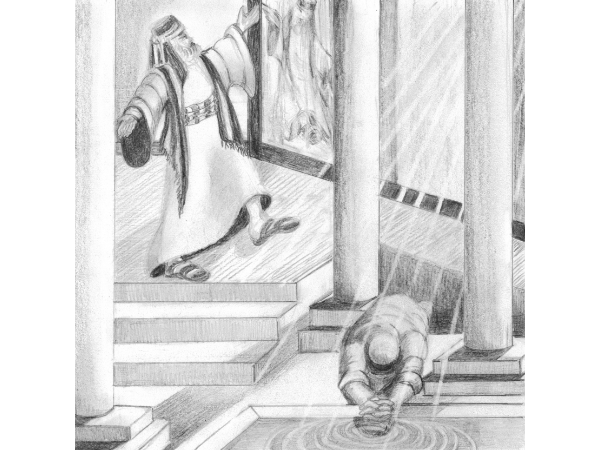
Pause—Lean on Jesus to guide you as you pray with the drawing, Reflections.
See—Look for the reflections that represent mirror images of pride and humility. How do the figures in the story respond to their reflections? How does their behavior mirror the condition of their heart?
Ponder—Ask yourself, How does my behavior mirror the posture of my heart?
Pray—In a spirit of confession and repentance, talk to Jesus about your honest acknowledgments.
Reflect—As you come to God with a true sense of your need for forgiveness, also remember the amazing sacrifice Christ made for you on the cross. Out of gratitude for his great mercy, we can simply rest in his love rather than strive for greatness.
Live—How will you live humbly today as his dearly loved child?
Reflections
Conclusion and Response
Those who exalt themselves will be humbled, and those who humble themselves will be exalted.
Matthew 23:12, NIV
Stories and images are Jesus’ preferred style of communication. We glean much about the heart of God from emulating the life and teachings of our humble Lord and Savior, Jesus Christ. The creativity of Jesus invites us into our own reflective process. Time and culture notwithstanding, we are faced today with the same choices as the early disciples.
The parables are a great place to prayerfully reflect. Each one is a teachable moment for all who have ears to hear and a hunger to know God intimately in Jesus. “Praying it slant” is a subversive way for Jesus to make himself known and to deepen the understanding of the Kingdom of Heaven for all of his most devoted followers—including you. Because it’s oblique, the style of Jesus’ parables is natural, conversational, and relational. As we’ve inclined our ear in God’s direction in prayer, we’ve seen the fingerprints of God everywhere.
In this hands-on-practice-text, our hope as creators is that you experienced the richness of the Word of God as the primary informant of your life of prayer and prayerfulness. Specifically, that the values and ethos of the parables have taught you a form of prayer that’s simple, natural, ordinary, and daily. How are you finding yourself praying differently as a result of the practice of lectio and visio divina?
The parables of Jesus are replete with pictures of contrast: self-centered worldly-mindedness or God-centered Kingdom-mindfulness. Each parable invites a response, mostly toward a radical departure of one’s normal, self-protecting idea or impulse. Each parable invites a deeper affection and unhurried intimacy with Jesus.
To notice, discern, pray, and work into your life the words of King Jesus and his Kingdom, however, is to walk faithfully with Jesus all of your days. The last will be first. The least will receive the most. The smallest is actually the greatest. The lost will be found. The morsel will be multiplied. The seed must first die in the ground before it lives to produce a crop.
To all who have ears to hear: Pray it slant and live humbly, abundantly, and fruitfully in the Kingdom of Heaven now and forever. Keep praying the parables of Jesus. Pass along the joy to others. Give God all the glory!
In the love of the Father, his beloved Son, Jesus, and the Spirit we call Holy. Amen.
Adapted from Praying the Parables of Jesus by Stephen A. Macchia and S. K. Skinner, published September 2025. Published with permission from NavPress.
Featured Product

Praying the Parables of Jesus offers an immersive encounter with Scripture, guiding readers to connect more deeply with the teachings of Jesus through prayerful reflection on His parables. In a world that constantly pulls our attention in countless directions, these 40 devotions invite us to pause, focus, and rediscover the quiet assurance of living out our faith with conviction.

Church Connect is operated by Tyndale House Publishers